

North Platte
It can take some time getting into North Platte (pop. 23,814), but despite the heavy-industrial initial appearance, there is a lot here to enjoy. The northern approach along US-83 crosses over the North Fork of the Platte River, taking a leisurely little swoop up and over it, passing scenic bluffs, then flashing back through a living history of the days when the train was king. Rusty old weed-filled tracks and abandoned shops and warehouses lie off to the side, steel and brick remnants of North Platte’s blue-collar trade and transportation heyday. From the south the entrance is less memorable, crossing the I-80 strip with its backlit plastic signs and anonymous franchise architecture.
Originally the site of a Union Pacific construction camp, North Platte nearly expired when the workers decamped for Colorado; however, the town’s 300 permanent residents were spared when the railroad chose it as a division point, securing its future. The city is still proud of its Bailey Yard, in 1995 deemed by Guinness World Records as the largest railroad classification yard in the world, at 2,850 ac (1,153 ha). A high-tech visitors center, complete with the eight-story Golden Spike Tower ($7), opened on the south side of the tracks in 2008, giving casual visitors and hard-core rail fans a bird’s-eye view of the intricate operations. Drive west on Front Street from downtown and you can’t miss it.
Many of the city parks feature railroad displays, including 100-acre Cody Park along US-83. Within its confines rests the only Challenger 3900 series steam locomotive on public view.
Before the railroad came through, North Platte was a key stop on both the Oregon Trail, which followed the Platte River west past Scotts Bluff and into Wyoming, and the Pony Express. At the dawn of the automobile age, North Platte played a starring role along the historic Lincoln Highway, the first transcontinental road, which followed the Oregon Trail route west along what is now US-30, US-50, and I-80, eventually ending in San Francisco.
But North Platte is most widely known as the home of Buffalo Bill Cody. The huge Buffalo Bill Ranch State Historical Park (308/535-8035, daily summer, $5 per car plus $2 adults), also known as Buffalo Bill Scout’s Rest Ranch, is 4 mi (6.4 km) northwest via US-30 and Buffalo Bill Avenue. It includes original dwellings on 23 surviving ac (9.31 ha) of Buffalo Bill’s original 4,000-acre spread. Cody’s house and some outbuildings look much the way they did when Buffalo Bill lived here, from 1879 to 1913. This is where Buffalo Bill originated his rodeo with the “Old Glory Blowout” in 1882 and later housed Buffalo Bill’s Wild West Show when not on the road. The whole town of North Platte still whoops it up with the Buffalo Bill Rodeo in June.
Besides Buffalo Bill memorabilia, North Platte has an interesting World War II canteen mock-up, preserved intact from the days when North Platte was a whistle-stop for troop trains, and a great Railroad Town, both on display at the Lincoln County Historical Museum (2403 N. Buffalo Bill Ave., 308/534-5640 daily summer only, $6 adults), adjacent to the Scout’s Rest Ranch.
Downtown North Platte, on the south side of the railroad tracks, has largely been superseded by the surrounding interstate sprawl, but the brick-paved streets here still hold some grand old buildings and a few nifty old neon signs, including one for the landmark Fox Theater, now called the North Platte Community Playhouse (E. 5th St. and N. Bailey Ave.). Just north of I-80 is one last great Buffalo Bill stop: the giant Fort Cody Trading Post (308/532-8081, free), a massive postcard and souvenir store with a good selection of books on Western Americana and, best of all, a fabulously detailed miniature working model of Buffalo Bill’s Wild West Show, complete with dancing bears, jumping horses, and hundreds of cowboys and Indians.
Because I-80 whips through North Platte, there’s no shortage of fast food or places to stay. The I-80 route replaced one of the country’s first cross-country roads, the Lincoln Highway, and if you’ve got some time (and an appetite), take a little trip along the old Lincoln Highway (US-30).
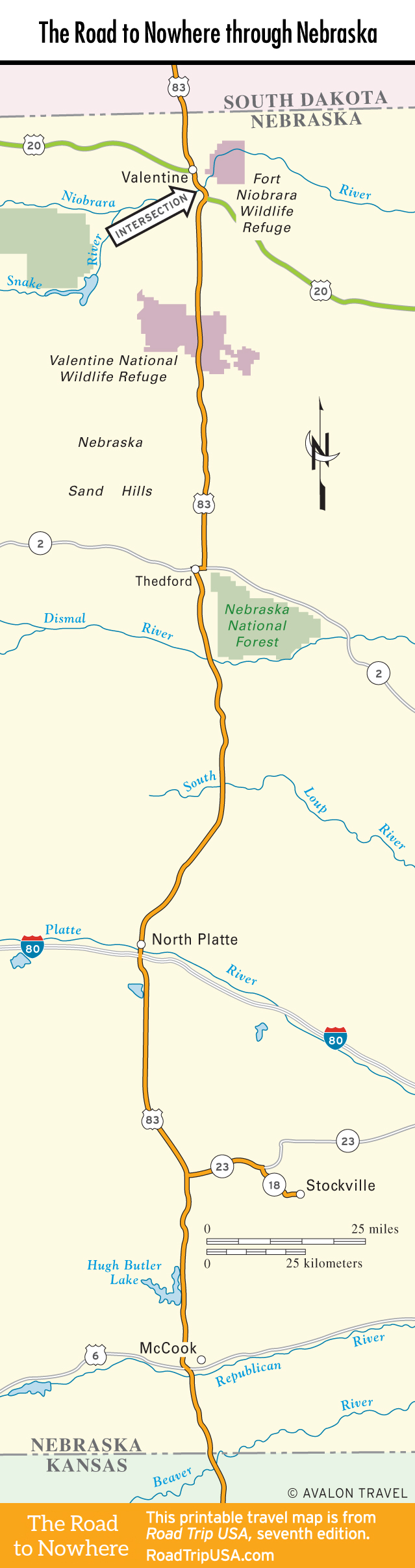
Travel Map of the Road to Nowhere through Nebraska
Related Travel Guides for the Road to Nowhere