



Montgomery
Original capital of the Confederate States of America, and now the state capital of Alabama, Montgomery (pop. 226,486) is among the more engaging destinations in the Deep South. Not surprisingly, much of what there is to see has to do with the Civil War, which officially started here when Jefferson Davis gave the order to fire on Fort Sumter. Montgomery survived the war more or less unscathed, and is now a pleasant little city with lovely houses lining leafy streets and an above-average range of restaurants, thanks to the presence of politicos and the nearly 5,000 undergrads at Alabama State College.
Montgomery’s landmark is the 1851 Alabama State Capitol (334/242-3935, daily, free), which served as the Confederate capitol for four months in 1861 and is still in use. A bronze star on the west portico marks the spot where Jefferson Davis took the oath of office as President of the Confederate States of America on February 18, 1861. Twin cantilevered spiral staircases surrounded by historical murals climb the three-story domed rotunda.
A single block west of the state capitol complex—mind-bogglingly close, considering the historically huge gulf between whites and blacks in Alabama—stands the Dexter Avenue King Memorial Baptist Church & Parsonage, a simple brick building where Martin Luther King Jr. served as pastor from 1954 to 1960. One of the key landmarks of the civil rights movement, it was here that supporters rallied around Rosa Parks in the Montgomery bus boycott of 1955-1956, eventually leading to an end to official segregation. You can visit and tour the Parsonage (309 S. Jackson St., 334/261-3270, Tues.-Sat.), where King and his family lived during the Montgomery years.
Montgomery has many powerful and affecting reminders of America’s tragic history of enslavement and racial discrimination. None is more memorable than the Legacy Museum (115 Coosa Street; closed Tuesday; $10), which opened in 2018. Located in a converted warehouse downtown, adjacent to Montgomery’s historic slave market, the museum recounts oral histories and traces institutional racism through the oppressive segregation of the Jim Crow era up to the present day, drawing dynamic connections across generations of Americans. It serves as an eye-opening and heart-rending introduction to the National Memorial for Peace and Justice, a short shuttle-bus ride away, where a 6-ac (2.4 ha) park presents a sculptural roll call of victims of lynchings and other forms of racial terror, their names engraved on more than 800 rusting steel slabs, each identifying the states and counties where they were killed. From the end of Reconstruction up through the 1950s, more than 4,000 Black people were brutally murdered by white mobs acting with total impunity—and often as part of celebratory public spectacles. Both sites support the mission of the Equal Justice Initiative (museumandmemorial.eji.org), which is committed to raising visibility about the continuing legacy of racial discrimination in the U.S. in the fight for basic human rights.
The Rosa Parks Library and Museum (252 Montgomery St., 334/241-8615, Mon.-Sat., $7.50), dedicated to Parks and the bus boycott, is open in the new Troy University library, next to the site of the bus stop where she refused to give up her seat for a white passenger, sparking the struggle.
Montgomery also has sights to see that have nothing at all to do with the Civil War or the civil rights movement. The baby blue 1952 Cadillac in which he died is one of the prime exhibits at the obsessive Hank Williams Museum (118 Commerce St., 334/262-3600, daily, $10), across from City Hall downtown, which documents his life and times. A photo-friendly statue of Hank stands a block north of the museum, outside the train station. His final resting place is in Oakwood Cemetery Annex (1304 Upper Wetumptka Rd.).
Another notable local was Zelda Fitzgerald, who was born and raised in Montgomery and later lived here with her husband, F. Scott, while he wrote Tender Is the Night during the winter of 1931-1932. The house they shared, south of downtown, has been converted into apartments. Apartment B on the ground floor is now the Scott and Zelda Fitzgerald Museum (919 Felder Ave., 334/264-4222, 10am-3pm Wed.-Sun., $10) which details their lives and works.
Where to Eat and Stay in Montgomery
At the east end of downtown, there’s a clutch of good “authentic Southern” restaurants within a short walk of the state capitol, including the cacophonously huge, and hugely popular, cafeteria-style Farmers Market Café (315 N. McDonough St., 334/262-1970). Another great traditional Deep South place is on the south side of town: Martin’s Restaurant (1796 Carter Hill Rd., 334/265-1767, Sun.-Fri.), southeast of the Alabama State University campus, gets votes for making the “World’s Best Fried Chicken,” and they also bake some pretty fine pies. Montgomery even has great fast food: Chris’ Hot Dogs (138 Dexter Ave., 334/265-6850, Mon.-Sat.), located three blocks west of King Memorial Baptist Church, is famous across the state for its spicy chili dogs and crispy fries. If you’ve got a hankering for juicy ribs and a slice of banana cream pie, visit Dreamland BBQ (12 W. Jefferson St., 334/273-7427), between the ballpark and the Hank Williams Museum.
Places to stay in Montgomery include the usual national chains, plus two good choices in downtown: a comfy Hampton Inn (100 Commerce St., 334/265-1010, around $125 and up), in a restored older building, and the luxurious Renaissance (201 Tallapoosa St., 334/481-5000, $160 and up). For more peace, quiet, and comfort, consider a night at the Lattice Inn (1414 S. Hull St., 334/263-1414), Montgomery’s nicest B&B.
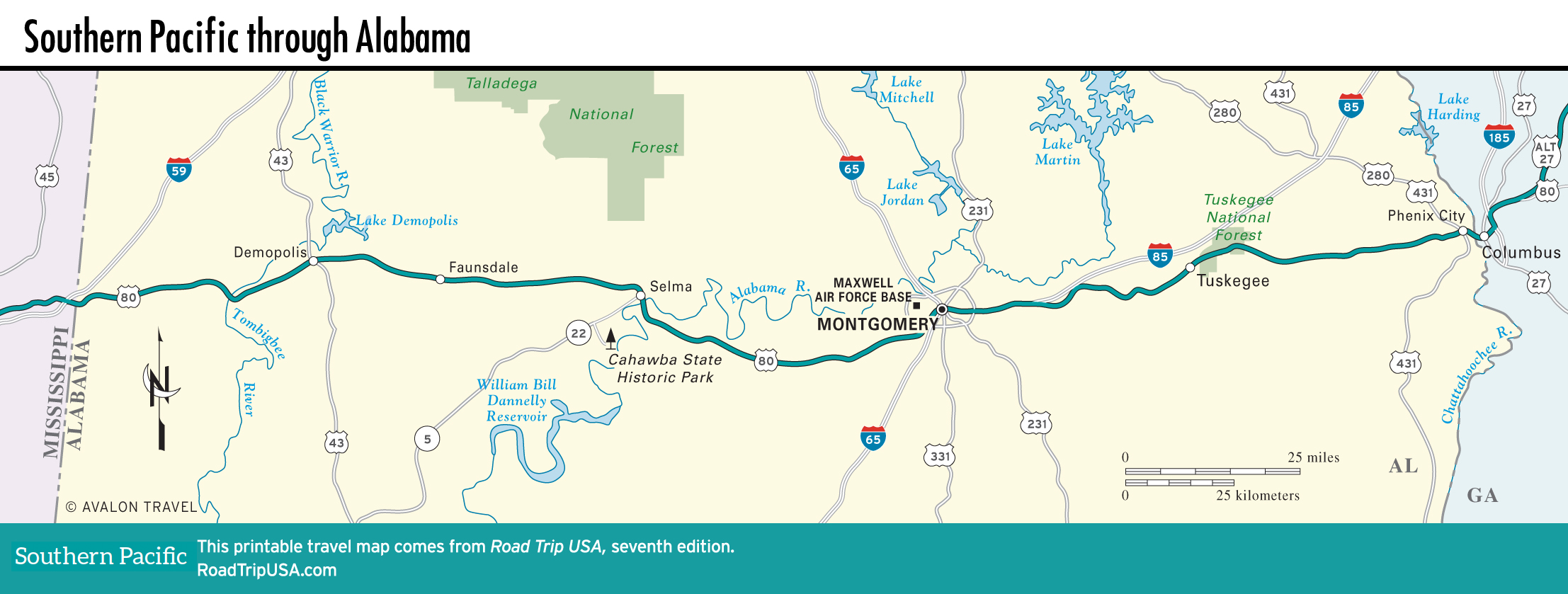
Map of the Southern Pacific Route through Alabama
Related Travel Guides