

Litchfield and Mount Olive
Litchfield
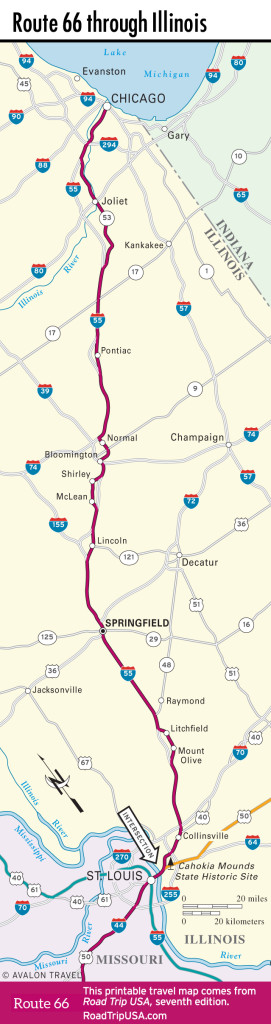
Between Springfield and Cahokia Mounds, the most interesting stretch of old Route 66 runs along the east side of the freeway for about a dozen mi (19.3 km), between Litchfield and Mount Olive. The first stop is Litchfield (pop. 6,753), an old coal-mining center that is home to a lively downtown flea market (second Sun. of the month, summer) and one of the best and most stylish Route 66 restaurants: the Ariston Café (413 N. Old Route 66, 217/250-2031, Tues.-Sun.), right in the heart of town at the junction of old Route 66 and Hwy-16. The menu is a step or two up from the usual roadside fare, with excellent fried chicken, while the white linen and refined decor have earned it a spot in the Route 66 Hall of Fame. The rest of Litchfield reeks of the old road, with cafés, motor courts, and old billboards aplenty, plus another old “ozoner,” the Skyview Drive-In (217/ 324-4451) on old Route 66 one mile (1.6 km) north of town.
Mount Olive
Some 9 mi (14.5 km) southwest of Litchfield, the hamlet of Mount Olive (pop. 1,959) was a bustling coal-mining center in the early 20th century. It’s now a sleepy little community, where the only signs of its mining past are in the Union Miners Cemetery, along old Route 66 at the northwest edge of town. Near the rear is a granite shaft rising from an elaborate pedestal, which serves as a memorial to Mary Harris “Mother” Jones (1837-1930), the celebrated union activist (and namesake of the liberal-minded magazine) who was famous for her passionate oratory, like the phrase “Pray for the dead, and fight like hell for the living.” She died here, possibly aged 100, while supporting a miners’ strike, and is buried nearby. Her grave is marked by a simple headstone.
For old-road fans, Mount Olive is also home to the oldest surviving service station on Route 66. While it’s no longer in business, the immaculate, restored Shell station downtown, long owned by Russell Soulsby is listed on the National Register of Historic Places.
Related Travel Guides
Map of Route 66 in Illinois