







Dubuque
Dubuque
At the southern end of an enjoyable ride, cruising up and down sculpted hills and winding past miles of Iowa prairie and river towns, the GRR rolls into Dubuque (pop. 57,941), named for the 18th-century French voyageur Julien Dubuque, who unsuccessfully mined lead on land acquired from the Spanish. Finding lead wasn’t the problem—Native Americans had dug lead by hand as early as 1680 for trade with the English—but getting it to market was. After the steamboat’s invention and forced removal of Native Americans in the late 1820s, mineral wealth became a major catalyst to settlement of the tristate area around Dubuque, as town names like Potosi, Mineral Point, New Diggings, and Lead Mine attest. During the Civil War, just five counties around here supplied all the lead for the entire Union war effort.
On the inland side of the compact downtown, a grand view of the city and the Mississippi valley can be had from the top of the Fenelon Place Elevator (daily Apr.-Nov., $3 round-trip), a historic funicular cable car that proudly holds the title of “World’s Steepest, Shortest Scenic Railway,” a miniature version of those found in the Swiss Alps. Hop on at the east end of 4th Street and ride up to the plush residential district on the hilltop.
On the other side of downtown, the Dubuque waterfront has been recharged by the National Mississippi River Museum and Aquarium (350 E. 3rd St., 563/557-9545 or 800/226-3369, daily Mar.-Oct., Tues.-Sun. Nov.-Feb., $20), one of the two biggest and best museums dedicated to the history and culture of Old Muddy (the other one is on River Island in Memphis). A highlight is the steamboat William M. Black, an official National Landmark. Other galleries include a National Rivers Hall of Fame, which tells the stories of explorers and adventurers like Lewis and Clark and John Wesley Powell. The introductory film, River of Dreams, is narrated by Mr. Lake Wobegon himself, Garrison Keillor.
The museum complex is at the heart of the America’s River complex, which also has the inevitable casino plus docks for scenic sightseeing and gambling boats, a nice riverside promenade, and the Grand Harbor Resort and Waterpark (563/690-4000, $109 and up), a deluxe hotel and 25,000-sq-ft (2,323-sq-m) water park.
Dubuque is a meat-and-potatoes place when it comes to food, and as in most of the Midwest, you should plan to dine early to catch restaurants before they close. Near the Fenelon Place Elevator, the Shot Tower Inn (390 Locust St., 563/556-1061) is a popular pizza place with an upstairs covered deck and beer by the pitcher. The one standout in Dubuque is the Pepper Sprout (378 Main St., 563/556-2167), where the range of dishes (and the big-city prices) proves that “Midwestern fine dining” is not an oxymoron.
East and west of Dubuque, US-20 offers a pair of excellent detours off the Great River Road. The ball field created for the movie Field of Dreams has become a minor tourist mecca for rural Dyersville, 26 mi (42 km) due west of Dubuque via US-20 or the surprisingly scenic paved Heritage Trail, which runs along an old railroad right-of-way.
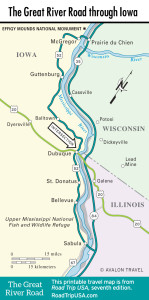
South of Dubuque, the GRR follows US-52 back up the bluffs and across 45 mi (72 km) of upland farms and wooded bottoms until the next Mississippi crossing at Sabula.
Dickeyville Grotto, WI
Across the river from Dubuque, the Wisconsin town of Dickeyville is home to one of the most interesting folk-art environments along the Mississippi: the Dickeyville Grotto (305 W. Main St., 608/568-3119, donation). Started by the priest Matthias Wernerus in 1925 as a memorial to three local boys killed in World War I, the Dickeyville Grotto consists of a series of caves, alcoves, and shrines made of poured concrete almost completely covered in shells, shards, minerals, and gems. Along with the expected Roman Catholic religious themes, parts of the grotto also exhibit a unique vein of patriotic Americana—highlighted by the “Patriotism in Stone” memorial to Christopher Columbus, George Washington, and Abraham Lincoln. With almost no commercialization, the grotto is open select hours, adjacent to the Holy Ghost Church, a block west of US-61.
Dickeyville can be reached a number of ways. It’s a quick shot north along US-151 from Dubuque, or from Prairie du Chien you can follow scenic Hwy-133 along the east bank of the Mississippi. If it’s summertime and you want an up-close look at the Mississippi, make your way to Cassville, a historic frontier town that holds one of the river’s few surviving car ferries. The ferry (608/725-5180, daily summer, Sat.-Sun. May and Sept.-Oct., $15 per car) has been running since the 1830s.
Iowa Travel Map
Related Travel Guides