


Ottawa
Originally an Algonquin settlement, Ottawa (pop. 994,837) was a small fur-trading and lumber-milling outpost until the 1850s, when Queen Victoria chose the city to be the national capital, a compromise answer to the bitter rivalry between Montreal and Toronto. Construction of the Parliament buildings began the following year, but government only became the largest employer after World War II, when the lumber mills began to decline. Today the train tracks and factories have been replaced by telecom and computer companies. Miles of parks and greenbelts, and the boating (or ice skating) along the Rideau Canal, make Ottawa one of the most peaceable and pleasant of the world’s capitals.
Orientation within Ottawa is easy: Parliament Hill, which holds the most prominent buildings, is on the north edge of town, with its back turned on the Ottawa River and the French-speaking province of Quebec. Getting around is easy, since most of the sights are gathered together around Parliament Hill and the adjacent ByWard Market. To see Ottawa, you should definitely park the car, get out, and walk (or bike, or rollerblade) around town.
Parliament Hill is home to the three buildings that compose Parliament, Canada’s seat of federal government. The architecture is reminiscent of England’s Houses of Parliament as redesigned by the cartoonist Charles Addams: Elegant, Gothic-style carved stone walls rise to copper mansard roofs topped with fantastically filigreed wrought iron. On the lawns of the Parliament buildings, the Changing of the Guard ceremony (daily at 10am late June or early July-late Aug., free) is extremely popular with tourists. On summer evenings, a sound-and-light show (10pm daily July, 9:30pm daily Aug., 9pm daily Sept., free) is projected onto the landmark facade.
East of Parliament Hill stands the National Gallery of Canada (380 Sussex Dr., daily May-Sept., Tues.-Sun. Oct.-Apr., C$16). Along with many floors of painting and sculpture from colonial times up to the present, including George Segal’s automobilia assembly The Gas Station, there’s also a large collection of Asian and Inuit art. Another striking piece of modern architecture stands upstream, west of Parliament Hill: the riverfront Canadian War Museum (daily, C$17), which documents Canadian soldiers’ bravery in war and peacemaking.
Where to Eat and Stay in Ottawa
Ottawa’s airport, with flights from most major U.S. hubs, is 20 minutes south of the city. The major east-west access is via Hwy-17, the Trans-Canada Highway; within town, this becomes the Hwy-417 freeway. From the south, Hwy-31 links up with Hwy-401, the long-distance freeway along the north shore of Lake Ontario.
The ByWard Market, east of Parliament Hill across the Rideau Canal, is the place to go for food. The market stalls offer a variety of fresh produce, cafés are abundant, and the restaurants and bars are lively and generally pretty good. Blue Cactus Bar & Grill (2 ByWard Market, 613/241-7061) is one of many good restaurants here, featuring Southwestern food in a cheery ambience and a late-night supper club. There’s a popular Streamline-style American diner, Zak’s Diner (14 ByWard Market, 613/241-2401, daily 24 hours), and the nice Shafali (308 Dalhousie St., 613/789-9188), on the east edge of ByWard Market, serving tandoori chicken, lamb madras, and other Indian specialties in a soothing saffron-colored room.
Places to stay in Ottawa are centrally located and not all that expensive—the capital of Canada is not a major tourist destination. Fairmont Château Laurier (1 Rideau St., 613/241-1414 or 866/540-4410, C$459 and up), situated in an opulent tower directly across from Parliament Hill, is a luxurious landmark. Finally, one of the most interesting budget options anywhere has to be the HI-Ottawa Jail Hostel (75 Nicholas St., 613/235-2595, C$27 and up), which occupies the old Ottawa jail, an 11-minute walk from Parliament Hill. Guests sleep on bunks in the old cells.
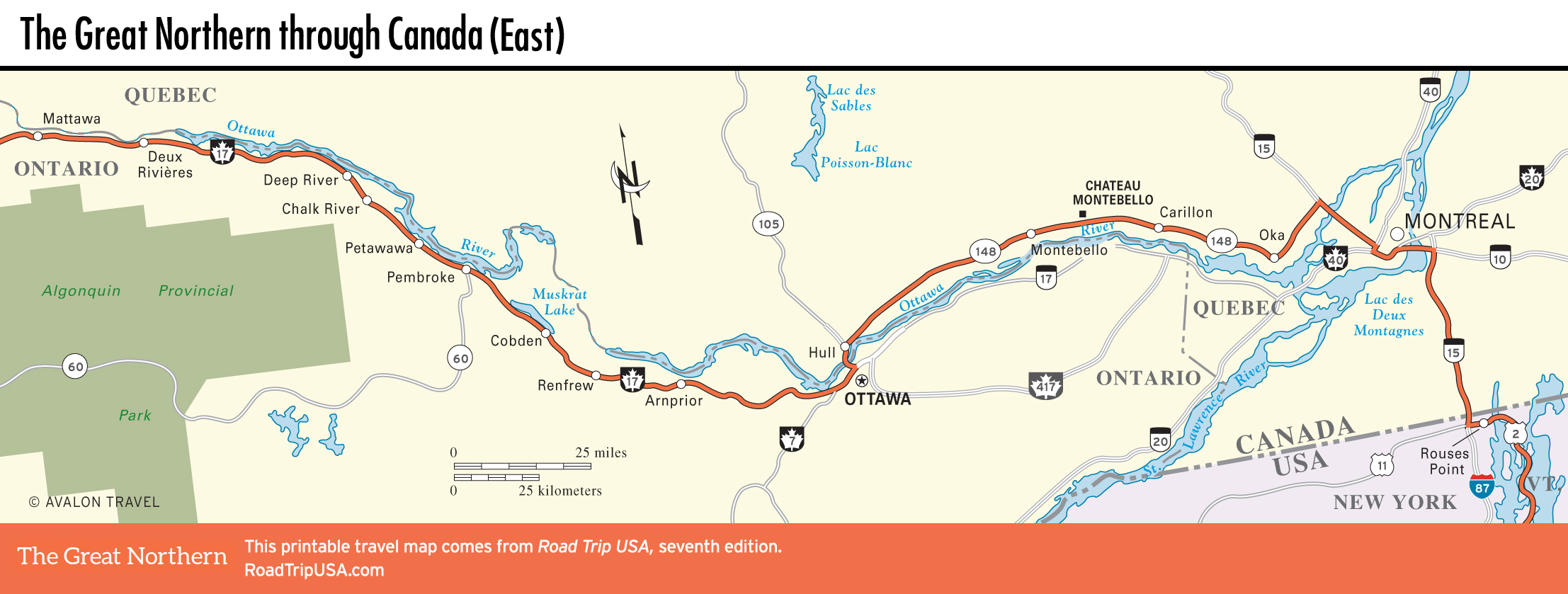
Related Travel Map
Related Travel Guides