

Town of Banff
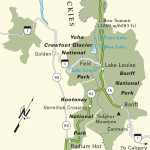
Southeast of Lake Louise, Hwy-93 and the Trans-Canada (Hwy-1) diverge, with Hwy-93 cutting due south through Kootenay National Park across southeastern British Columbia toward the U.S. border. That is the route we follow, all the way south to Mexico, eventually, but anyone in his or her right mind will want to make the 20-mi (33-km) detour southeast along Hwy-1 to visit the beautiful Town of Banff, home of the landmark Fairmont Banff Springs Hotel, the biggest and most impressive of the grand old Canadian Pacific hotels. When it opened in 1888, this was the largest hotel in the world, with 250 rooms; over the years, the hotel has been rebuilt and expanded to its current 764 rooms, most of which are booked up months in advance. Spreading between the hotel and Hwy-1, the Town of Banff has grown into the tasteful but bustling commercial center of the Canadian Rockies, with a year-round population of some 7,800 people, and many times that many visitors daily during the peak summer season. Though the commercialism can detract from the natural splendor, Banff is definitely a pleasant place to while away some time.
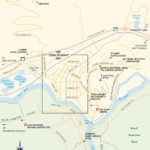
For the most spectacular introduction to Banff, head up Mountain Avenue, where the Banff Gondola (403/762-7475, daily, C$53 and up) will take you 2,440 feet up Sulphur Mountain for a grand view over the entire Bow Valley. The “springs” in the Fairmont Banff Springs Hotel’s name refers to actual hot springs; the original hot springs that spurred the growth of Banff have been closed to bathers and converted into the Cave and Basin National Historic Site (403/762-1566, daily summer, C$8), west of town at the end of Cave Avenue, where exhibits detail the underlying geology that makes hot springs happen.
The town’s main drag, Banff Avenue, has all the cafés, restaurants, and shopping you could want. But if the weather’s bad (if it’s not, you ought to be outdoors, enjoying Mother Nature!), you can learn about Banff and the Canadian Rockies in the local museums. Best first stop is the Banff Park Museum (Wed.-Sun., C$4), near the river at the foot of Banff Avenue, a Victorian-era remnant (it was built in 1903) that displays the taxidermied remains of typical park wildlife. Around the corner, a half block down from pleasant riverside Central Park, the Whyte Museum of the Canadian Rockies (111 Bear St., daily, C$10) has an expansive collection of historic books, postcards, paintings, and photographs, all capturing various aspects of the mountains and their inhabitants.
One of many cultural events that take place in Banff is the Banff Mountain Film and Book Festival (403/762-6100), where the world’s best adventure-travel and mountain-climbing films and mountain literature are featured every November.
Accommodations and Food in the Town of Banff
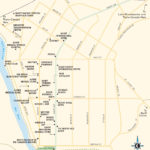
So long as you plan ahead, and can afford to enjoy some of Canada’s most expensive hotels and restaurants, the Town of Banff makes a great place to visit. Because the Town of Banff is located within the confines of Banff National Park, development has been limited—so much so that summertime accommodations here can be hard to come by, and expensive. Throughout the summer, hotels are booked up solidly well in advance, and rates start around C$200 for a basic room. (Winter rates are usually less than half that.) A dozen places are within a short walk of downtown: Brewster’s Mountain Lodge (208 Caribou St., 403/762-2900, C$109 and up) has spacious rooms, while rooms at the landmark Fairmont Banff Springs Hotel (403/762-2211 or 866/540-4406, C$459 and up), when available, climb quickly into the four-digit range.
If you have trouble finding an affordable room in Banff, consider taking a trip farther east to Canmore, a lively little city on Hwy-1, just east of the park’s boundary, where the nonprofit Alpine Club of Canada operates the HI-Canmore Hostel (403/678-3200 ext. 0, C$30 and up).
Restaurants in Banff are plentiful, good, and wide-ranging—there are more than 100, which works out to 1 for every 70 or so residents. One of the most popular places with locals and visitors alike is Melissa’s Missteak (218 Lynx St., 403/762-5511, 7am-9:30pm daily, 7am-11pm daily summer) on the west side of downtown. Housed in a 1928 log building with a nice bar and an outdoor deck, Melissa’s serves great pancakes (with real maple syrup) and beefy burgers. The ever-popular Wild Bill’s Legendary Saloon (201 Banff Ave., 403/762-0333) has good food and drink (mostly the latter) right at the center of town. Central Banff also has many Japanese restaurants and a Greek café.
Parks Canada (855/862-1812) operates three campgrounds along Tunnel Mountain Road, 2 mi (3 km) east of downtown, which have over 800 sites altogether; all the campgrounds have hot showers, and many sites have full or partial RV hookups. Also on Tunnel Mountain Road is the large HI-Banff Alpine Centre (403/762-4123, C$33-107).
For comprehensive information on Banff, head downtown to the large visitor information centre (224 Banff Ave.), which is home to both the commercially oriented Banff-Lake Louise Tourism Bureau (403/762-8421) and the staff of Banff National Park (403/762-1550).
Related Travel Guides
Travel Maps of the Border to Border Route through Canada