

Charleston
The Charleston accent is famous throughout the South. The word “garden” here is characteristically pronounced “gyarden,” and “car” is “kyar,” while the long “a” of Charleston (usually pronounced “Chaaahrleston”) is as distinctive as JFK’s “HAAH-vahd.”
Established in 1670 as the capital of South Carolina, Charleston, more than any other Deep South city, proudly maintains the aristocratic traditions established during the plantation era. Then the elite would flee the heat, humidity, and mosquitoes of their lowland fiefdoms and come here to cavort in ballrooms and theaters. Still ruled by old money, though no longer the state capital, Charleston is both pretentious and provincial; locals like to say that Charleston is the place where the Ashley and Cooper Rivers meet to form the Atlantic Ocean. Though there are clear divides between the haves and have-nots, Charleston is surprisingly cosmopolitan, accommodating a historic ethnic mix of French Huguenots, Catholic Acadians, and Afro-Caribbeans, who collectively introduced the wrought-iron balconies and brightly colored cottages that give the city much of its charm. George Gershwin’s opera Porgy and Bess, for example, was inspired by life in Charleston’s Creole ghetto, specifically Cabbage Row, now a tidy brick-paved alley off Church Street.
Despite suffering through a devastating earthquake, two wars, and innumerable hurricanes, resilient Charleston remains one of the South’s most beautiful cities. Impressive neoclassical buildings line the streets, especially in the older, upmarket sections of town south of Broad Street and along the waterfront Battery. Charleston’s many small lush gardens and parks make it ideal for aimless exploring on foot rather than by car. If you’d like a friendly, intelligent guide to show you around, contact Ed Grimball (843/813-4447).
The Civil War Fort Sumter and many of the mansions and churches are all open to visitors, but it’s the overall fabric of Charleston, rather than specific sites, that is most memorable. That said, the 1828 Greek Revival Edmondston-Alston House (21 E. Battery, daily, $11) is definitely worth a look, as is the beautiful spire of St. Michael’s Episcopal Church (71 Broad St., daily) which was modeled on the London churches of Christopher Wren. A quarter mile north, at Meeting and Market Streets, is the mostly open-air City Market, known as the “Ellis Island of Black America,” since 40 to 60 percent of enslaved people arrived in the colonies here. The market now houses a range of souvenir shops and touristy restaurants.
The Charleston RiverDogs (843/723-7241), a Yankees farm team, play ball on the banks of the Ashley River.
Charleston’s annual arts-and-opera Spoleto Festival USA (843/579-3100) is held over two weeks in May and June.
Where to Eat and Stay in Charleston
Charleston supports a number of excellent eateries at all price ranges. Around the City Market, you’ll find Hyman’s Seafood (215 Meeting St., 843/723-6000), which has a variety of fresh fish entrées for around $15-25; expect a wait. More sedate and expensive dinner places include the stylish SNOB (Slightly North of Broad; 192 E. Bay St., 843/723-3424) and Magnolias (185 E. Bay St., 843/577-7771), serving inventive takes on traditional Lowcountry food.
Charleston’s accommodations tend toward the luxurious and expensive. Dozens of old-fashioned but well-appointed B&Bs charge upward of $200. The elegant John Rutledge House (116 Broad St., 800/476-9741) offers four-star comfort in a converted 1763 house. Fronting the Battery, the romantic Queen Anne Two Meeting Street Inn (2 Meeting St., 843/723-7322) has been welcoming guests for over 50 years. Hotels in the historic district are similarly expensive, though you’ll find a handy Days Inn (155 Meeting St., 843/371-3850, $110 and up) downtown. Families will appreciate the large rooms and big made-to-order breakfast at Embassy Suites (337 Meeting St., 843/723-6900, $179 and up), housed inside the original Citadel.
The Charleston Visitor Center (375 Meeting St., 800/774-0006, daily) is a good first stop. It is free to ride the DASH shuttle buses that follow several routes downtown.
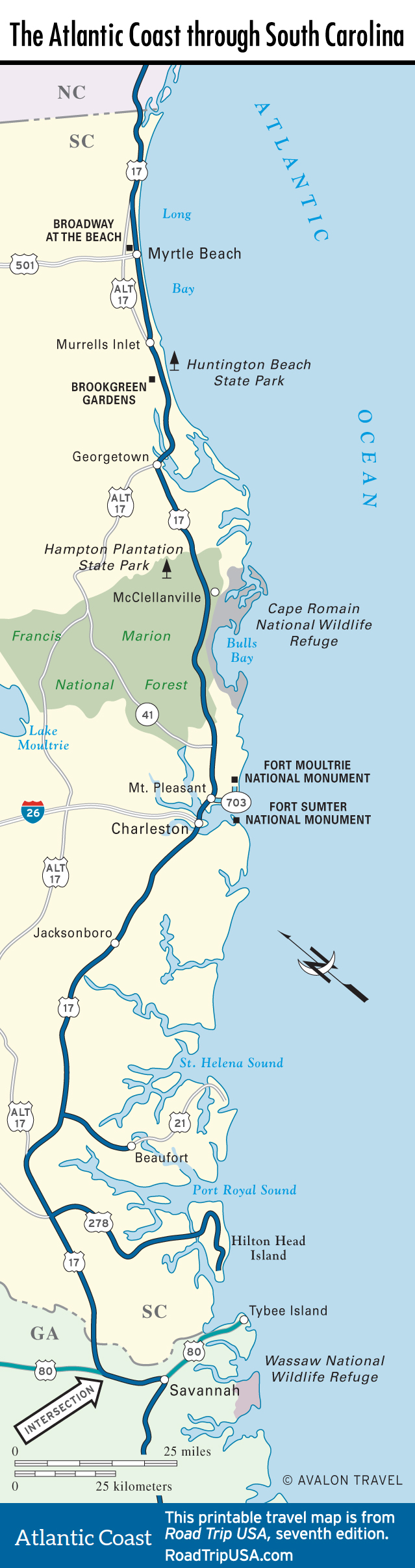
Related Travel Map
Related Travel Guides